

PMOS/PCOS Diet: What to Eat, What to Avoid and What Works
There is no single best PCOS diet, and the one that works is the one you can eat for years.
PCOS, renamed polyendocrine metabolic ovarian syndrome, or PMOS, in May 2026, is driven substantially by insulin resistance, and eating in a way that steadies insulin improves cycles, androgen symptoms and long-term metabolic risk. That is a question of overall pattern, not of specific foods.
What is the best diet for PCOS/PMOS?
The one you will still be following next year. Any diet composition consistent with general healthy-eating guidelines will deliver health benefits, and that dietary changes should be tailored to your own food preferences. Restrictive eating has a high failure rate, and a plan abandoned after six weeks does nothing for a lifelong condition. Insulin sensitivity, blood lipids and cycle regularity can improve on the strength of what and how you eat, whether or not the scale moves.
Why is insulin the lever?
Insulin resistance is present in most people with the condition, and it sits upstream of symptoms that look purely reproductive.
The mechanism is a loop. When cells respond poorly to insulin, the body produces more of it. Higher circulating insulin prompts the ovaries to produce more androgens. Raised androgens disrupt follicle development, which is what produces irregular cycles, difficulty ovulating and androgen-related symptoms like acne and excess hair growth.
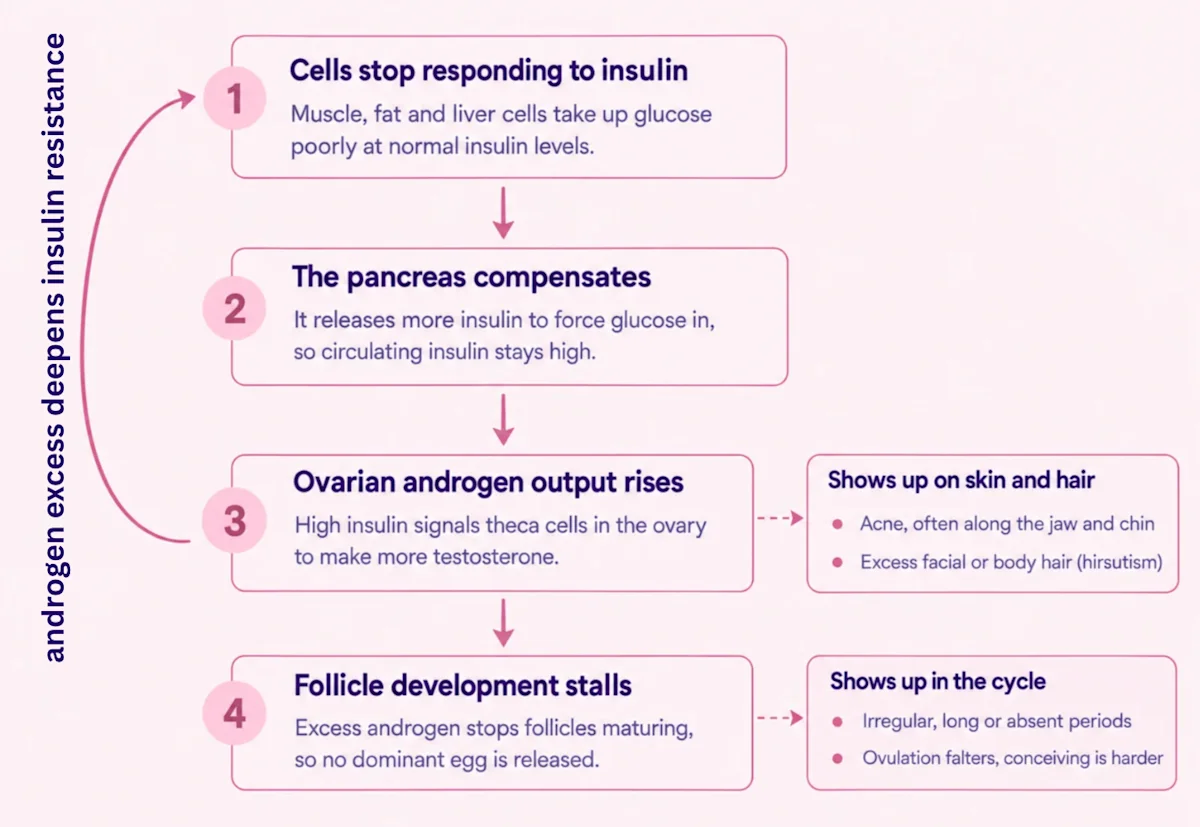
Food influences that loop directly, through how much and how fast glucose arrives in the bloodstream. This is why a dietary pattern that flattens glucose spikes tends to improve symptoms across all three groups at once, and why "just lose weight" was always an incomplete instruction.
Four principles that do the work
Principle 1: Choose better-quality carbohydrates, rather than cutting them out. Prioritise wholegrains, legumes, fruits and vegetables for their fibre and nutritional value. Limit refined grains and foods high in added sugar, and remember that portion size and meal composition also influence blood glucose. Completely eliminating carbohydrates is unnecessary for managing PCOS/PMOS.
Principle 2: Look at combinations. Replace “never eat a carbohydrate on its own” with “pair carbohydrates with protein, fibre or healthy fats where practical.”
Principle 3: Eat balanced meals at intervals that suit your routine. Aim for regular, satisfying meals that include protein, fibre and healthy fats to support fullness and help manage blood glucose. Avoid overly restrictive eating, and choose a meal pattern that fits your lifestyle and hunger cues.
Principle 4: Stay active and include strength training. Regular physical activity and resistance training can improve insulin sensitivity through complementary mechanisms. Building and maintaining muscle helps the body use glucose more effectively, supporting metabolic health in people with PCOS
Foods to eat and foods to avoid with PCOS
No food is banned, and no food is a treatment. What follows is a quality hierarchy, not a moral one.
Eat freely | Eat mindfully | Limit |
|---|---|---|
Non-starchy vegetables, leafy greens, salads | Wholegrains: freekeh, bulgur, oats, barley, brown or parboiled rice | Sugary drinks, fresh juice, sweetened karak |
Pulses: lentils, chickpeas, beans, foul | Whole fruit, dates paired with protein or fat | White bread, white rice, refined flour pastries |
Fish, seafood, eggs, poultry, lean meat | Nuts, seeds, olive oil, tahini, avocado | Arabic and Western sweets as a daily habit |
Plain laban, yoghurt, labneh | Starchy vegetables: potato, corn, pumpkin | Deep-fried foods eaten regularly |
The "limit" column is about frequency, not prohibition. A plan that rules out everything you enjoy is the plan you will stop following.
PCOS diet for the Gulf
Most PMOS diet advice online is written around a Western plate, which makes it hard to apply to a regional table. Below are some options for the UAE:
Balaleet. This familiar breakfast of sweetened vermicelli topped with egg can be high in refined carbohydrates and added sugar. Keep the traditional dish if you enjoy it, but consider a smaller serving alongside extra eggs, plain laban or unsweetened yoghurt. Reducing the sugar in the vermicelli is another simple adjustment.
Regag and chebab. These popular breads and pancakes can contribute substantial carbohydrates, particularly when eaten with honey, sugar or sweet spreads. Pair them with eggs, cheese or labneh, and choose less-sweet toppings more often. The aim is to add protein and make the meal more filling, not to ban bread.
Rice dishes. Machboos, kabsa and biryani are built on white rice, the fastest-releasing staple on the regional table. Parboiled or brown rice lowers the glucose response, but the easier change is proportion: fill half the plate with salad and vegetables, keep the meat or fish generous, and let rice occupy a quarter rather than the base.
Karak. A daily habit worth auditing, because the sugar load is substantial and liquid sugar produces a sharper glucose rise than the same sugar in food. Reducing it gradually works better than eliminating it.
Dates. Not off-limits, and a poor thing to feel guilty about. Eaten alone they raise glucose quickly; with nuts, laban or as part of a meal, the response is meaningfully flatter.
Lentils, foul and freekeh are among the best staples available for this condition, and they are already regional. Foul medames for breakfast is close to an ideal PCOS meal: high fibre, high protein, slow release.
Ramadan. The suhoor–iftar pattern concentrates eating into two meals, which can produce large glucose swings. A suhoor weighted towards protein, fibre and fat sustains energy longer. If you take metformin or fertility medication, plan timing changes with your doctor before Ramadan rather than during it.
Vitamin D. Despite abundant sunshine in the UAE, vitamin D deficiency remains a concern. Indoor lifestyles, limited sun exposure during the hotter months and consistent sun protection can all affect vitamin D status. Include food sources such as oily fish, eggs and fortified dairy products where available, and seek personalised advice from a healthcare professional about testing or supplementation if needed.
PCOS & Weight loss

Weight management in PCOS/PMOS should be approached individually, taking into account nutritional needs, lifestyle and overall health. A balanced diet that includes adequate protein, fibre-rich carbohydrates and healthy fats, alongside regular physical activity, can support metabolic health and help with weight management where appropriate. Rather than following restrictive diets, focus on sustainable habits that can be maintained long term. Importantly, improvements in insulin sensitivity and overall health can occur even without weight loss, making wellbeing and metabolic markers valuable measures of progress beyond the number on the scale.
The Ovasave Take-Home
There is no special PCOS diet, and anyone selling you one is ahead of the evidence. What works is a sustainable pattern built on carbohydrate quality, protein and fibre at every meal, with daily exercise and resistance training.
The changes worth making are usually about proportion and pairing rather than replacement. And if the scale does not move, the metabolic benefits still accrue.
From Ovasave team: If your cycles have gone quiet, an at-home fertility and hormone test gives you baseline numbers to track against, and our guide to the progesterone challenge test explains a common next step when periods have stopped altogether. One thing diet does not change is ovarian reserve, which is a separate question with a separate marker. If conception is on your mind alongside all this, an AMH test kit answers it directly.
Quick FAQs
Nothing is strictly forbidden. The things worth reducing in frequency are sugary drinks and juice, refined flour, white rice as an everyday base and regular deep-fried food, all of which produce fast glucose rises with little fibre or protein alongside.
No. It is a chronic condition that is managed rather than cured, and no food, supplement or home remedy resolves it. Diet and activity can substantially reduce symptoms, restore ovulation in many people and lower long-term metabolic risk, which is a meaningful outcome even though it is not a cure.
It is not recommended to follow unduly restrictive, or nutritionally unbalanced diets. Changing carbohydrate quality such as wholegrains and pulses in place of refined flour and white rice, and pairing carbohydrates with protein and fibre achieves the same goal works just as well.
Cycle changes usually take a few months, since follicle development runs on roughly a 90-day timeline, while energy and metabolic markers often shift sooner. Judge it over three to six months rather than three to six weeks.

References
Ovasave’s articles are written after carefully evaluating evidence-backed sources and are reviewed by medical professionals to ensure the highest standards of accuracy.
Teede HJ, Piltonen T, et al. Polyendocrine metabolic ovarian syndrome, the new name for polycystic ovary syndrome: a multistep global consensus process. The Lancet, 12 May 2026. https://www.thelancet.com/journals/lancet/article/PIIS0140-6736(26)00717-8/fulltext
The American Journal of Managed Care. PCOS Renamed PMOS in Landmark Shift Reflecting Metabolic and Endocrine Features. https://www.ajmc.com/view/pcos-renamed-pmos-in-landmark-shift-reflecting-metabolic-and-endocrine-features
Prevalence and influencing factors of vitamin D deficiency in women with polycystic ovary syndrome: a systematic review and meta-analysis. Frontiers in Nutrition 2026. https://www.frontiersin.org/journals/nutrition/articles/10.3389/fnut.2026.1865564/full
Prevalence and Clinical Features of Polyendocrine Metabolic Ovarian Syndrome in the Gulf Cooperation Council Countries: A Systematic Review and Meta-Analysis. PMC. https://pmc.ncbi.nlm.nih.gov/articles/PMC13361794/