

How Understanding My Sperm Can Enhance My Fertility Journey
Nobody hands you a manual for this. Maybe you've been trying for a while. Maybe you're just thinking ahead. Either way, you're suddenly asking questions about your own body that you've never had a reason to ask before, and wondering whether you'd even know if something was off.
Here's the reassuring part: A sperm test, also called a semen analysis, is a quick and reliable way to know if your sperm is healthy. Low sperm count and poor sperm movement usually cause no symptoms. You can’t tell by how you feel or by how your semen looks. The test checks three main things: how many sperm you have (sperm count), how well they swim (motility), and their shape (morphology). Under the World Health Organization’s reference limits, a healthy result means at least 16 million sperm per mL, at least 42% moving, and at least 4% normally shaped.
One test, a handful of numbers, and you know where you stand. And unlike a lot of fertility factors, this one responds to what you do.
Let's walk through it, what sperm actually is, what healthy sperm looks like on a test, and what genuinely helps.
The importance of a sperm in the fertility journey
Let's start with something that doesn't get said enough: fertility isn't a women's issue.
Male factors are involved in roughly half of all cases. The World Health Organization (WHO) defines infertility as “a disease of the reproductive system defined by the failure to achieve a clinical pregnancy after 12 months or more of regular unprotected sexual intercourse," and about one in six people worldwide experience it at some point in their lives.
On the male side, the WHO points to three main causes: trouble releasing semen, low or absent sperm, and sperm with unusual shape or movement. The good news? One simple test can help you there.
Understanding sperm
What is sperm?
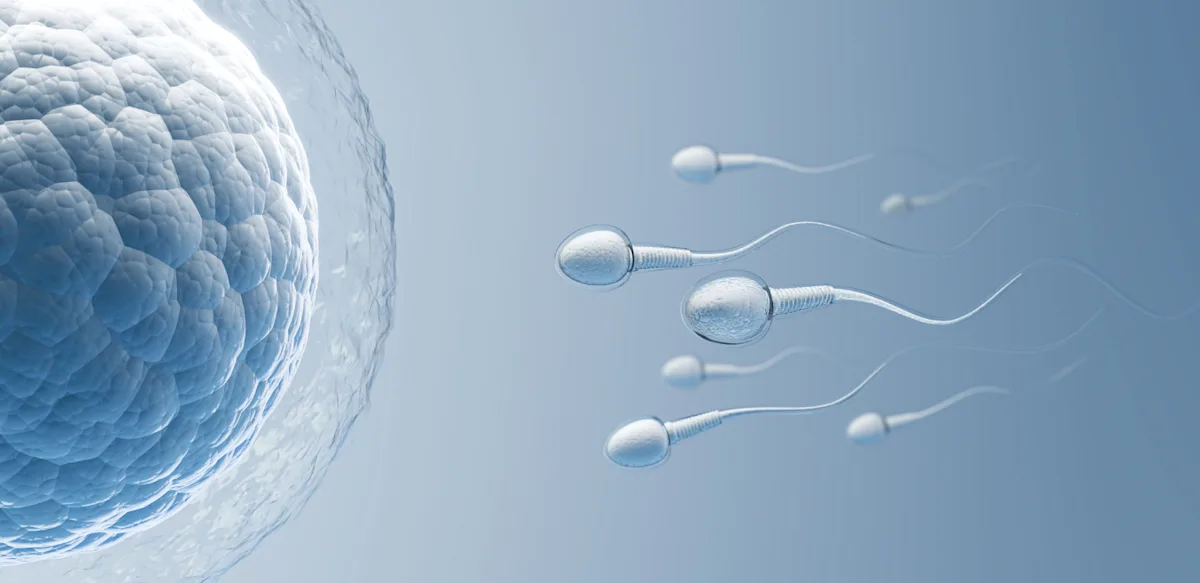
Quick clarification, because these two words get mixed up constantly. The sperm is the cell, and semen is the fluid carrying it. You can produce a perfectly normal amount of semen with very little sperm in it which is exactly why you can't tell anything by looking.
Each sperm cell has three parts, and each sperm cell function does a specific job:
Part | What it does |
|---|---|
Head | Carries your DNA, and helps the sperm get inside the egg |
Midpiece | Generates the energy it needs to swim |
Tail | Pushes it forward |
How is sperm produced? Inside tiny tubes in your testicles. Building one can take up to 90 days which means the sperm in today's sample was made weeks ago. So anything you change today shows up in a test two to three months from now. Not next week.
Once inside the body, sperm are tougher than you'd think. They can survive in the fallopian tubes for up to 7 days after sex.
On the other hand, how long does sperm live outside the body? Minutes.
Types of sperm cells
Every sample is a mixed bag.
X-bearing and Y-bearing. Half carry an X chromosome, half a Y which means the sperm decides the baby's sex, not the egg.
Normal and odd-shaped. Here's one that surprises people: even in fertile men, most sperm are oddly shaped. The WHO cut-off is at least 4% normal, so 96% can still look wrong but your sample is still fine!
Movers and non-movers. Some swim forward, some wriggle on the spot, some don't move at all. All three turn up in a normal sample.
Sperm color and its implications
Color | Usual cause | What to do |
|---|---|---|
Whitish-grey | Normal | Nothing |
Yellow or yellowish | A trace of urine, a long gap since you last ejaculated, food like turmeric, garlic or onions, smoking, some medicines and vitamin B | Usually fine if it passes |
Yellow-green | Possible infection, including STIs, or too many white blood cells | See a doctor |
Deep yellow with yellow eyes | Possible liver problem | See a doctor soon |
Pink, red or brown | Blood in the semen | See a doctor |
Healthy semen is whitish-grey and thick, a bit like raw egg white. Most color changes are harmless, but a few are worth a second look. So whether yellowish sperm is good or bad depends on what comes with it. If you're wondering “why is my sperm yellow?”, it's usually a long gap since you last ejaculated, or a trace of urine, and it sorts itself out. Worth seeing a doctor if yellow sperm arrives with fever, chills, pain when you urinate or ejaculate, a bad smell, or yellowing of your eyes or skin.
However, one thing that the color won't tell you is your sperm count.
Sperm test
What is a sperm test?
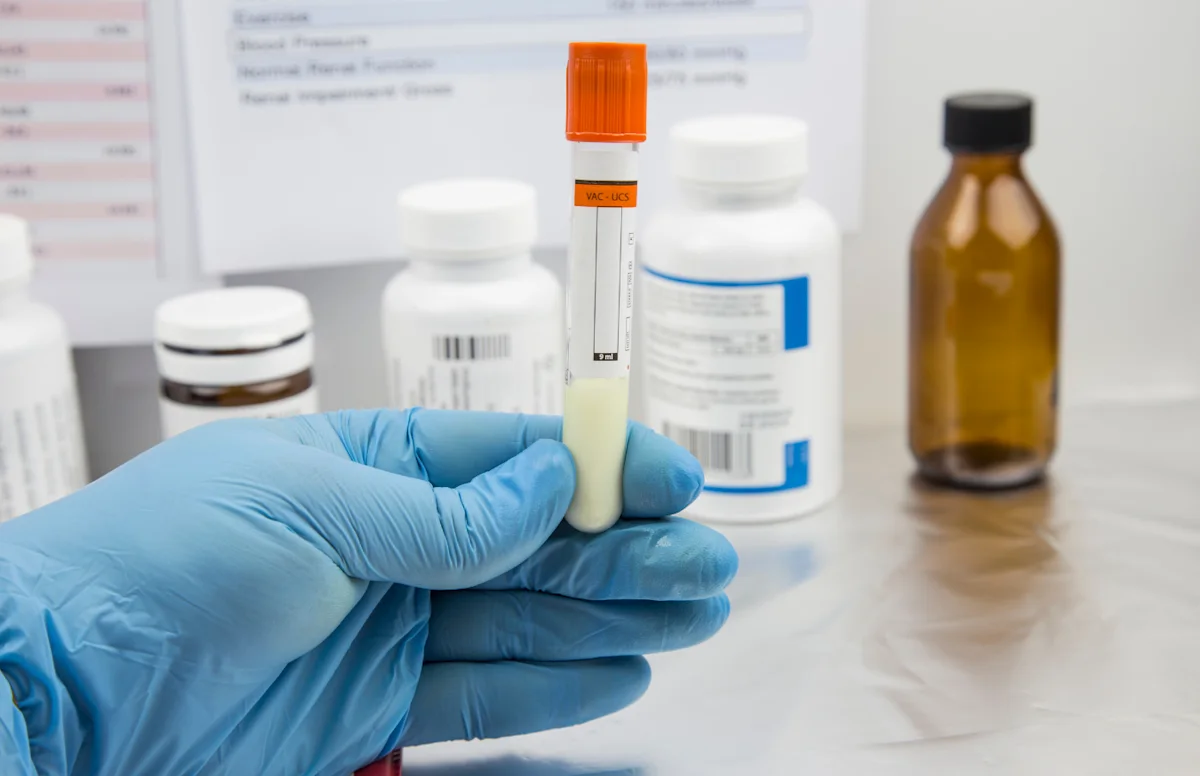
A sperm test or a semen analysis is a lab check that counts your sperm, measures how well they move, and looks at their shape. Quick, cheap, non-invasive.
And if the idea feels awkward: it's a routine test labs run every day, and the single most useful thing you can do here. No prize for avoiding it.
You need to skip ejaculating for two to five days beforehand, then produce a sample into a sterile pot. Done at home, it needs to reach the lab within about an hour.
A home sperm count test is a fair starting point, but most kits only count. Sperm analysis at home won't tell you about movement, shape or volume, so a normal result doesn't mean it's all clear.
Understanding a sperm analysis
One sample isn't a verdict. Counts swing around a lot day to day, so a second sample a few weeks later confirms the first. A single low result is common and often doesn't repeat, so try not to read too much into one number!
Interpreting sperm count test results
Your results get compared against the WHO's reference limits (6th edition). Scoring below one lowers your odds but it doesn't rule anything out.
What’s measured | WHO reference range |
|---|---|
Total sperm count in ejaculate | ≥ 39 million |
Total sperm count in ejaculate | ≥ 1.4 mL |
Sperm Concentration | ≥ 16 million/mL |
Total Motility (Progressive + Non-Progressive) | ≥ 42% |
Sperm Vitality (Live Sperm) | ≥ 54% |
Normal Morphology: | ≥ 4% |
pH | ≥ 7.2 |
Now the part that catches most men off guard is that there aren’t usually signs of low sperm count or weak sperm. Men with very low counts feel completely normal, and low sperm motility symptoms are just as invisible.
So if you're asking how to know if my sperm is healthy, or how to know if my sperm is fertile: you can't. Not by looking, not by how you feel.
The only real warning signs point to a cause. Pain, swelling or a lump in the testicles, a past injury or undescended testicle, or signs of low testosterone. Everything else, only the test tells you.
Factors influencing sperm health
Substances. While smoking and drugs should be stopped immediately, alcohol should be consumed in moderation
Exercise. Exercising every day for roughly 30 minutes will do wonders for your sperm health
Clothing. Wear loose-fitting underwear as tight underwear can raise the temperature
Steroids. Steroids deserve their own line. Taking testosterone can switch off your body's own production and can stop sperm entirely. Usually reversible, but recovery can take a year or more!
Heat. The NHS flags pesticides, solvents and heavy metals at work. Hot tubs, saunas, a laptop on your lap for hours, long drives, same mechanism every time. Heat.
To know more about what will help you boost your sperm quality naturally and what you should look for in your supplements, feel free to read our blog, “How to increase sperm count,” and check out our male fertility supplement with CoQ10 boost.
The Ovasave Take-Home
Understanding your sperm turns a vague, low-level worry into something you can act on.
Get a sperm test rather than guessing, because a low count has no symptoms and nothing you can see. Treat the limits as context rather than a pass mark, and confirm anything unusual with a second sample.
Then work on what genuinely moves the numbers such as alcohol, smoking, weight, heat, steroids and give it three months.
And if the results aren't what you hoped for, that's a medical issue with medical solutions. Not a verdict on you. A lot of it is fixable, and finding out early is the whole advantage. If your partner is testing too, an at-home fertility and hormone test covers her side of the picture, so you're both working from facts instead of guesswork.
Quick FAQs
At least 16 million per ml. Falling below lowers your odds rather than making pregnancy impossible.
Only through a sperm test. Color, volume and how you feel tell you nothing at all about count, movement or shape.
They can stay up to 7 days in the fallopian tubes. Outside the body, only minutes.
About three months. Sperm can take up to 3 months to build and mature, so today's changes show up two to three months from now.
Thickness isn't a fertility measure, so how to make sperm thicker and stronger isn't a goal a lab would recognise. It varies with hydration and how long it's been since you last ejaculated. What matters is count, movement and shape none of which you can see.
They count reliably, but most measure nothing else. Since movement and shape matter as much as count, a normal home result doesn't rule out a problem.

References
Ovasave’s articles are written after carefully evaluating evidence-backed sources and are reviewed by medical professionals to ensure the highest standards of accuracy.
World Health Organization. Infertility fact sheet. https://www.who.int/news-room/fact-sheets/detail/infertility
World Health Organization. WHO laboratory manual for the examination and processing of human semen, 6th edition (2021), lower reference limits. https://mft.nhs.uk/app/uploads/sites/4/2023/01/Lower-reference-limits-2021.pdf
NHS. Low sperm count. https://www.nhs.uk/conditions/low-sperm-count/
NHS. Infertility Causes. https://www.nhs.uk/conditions/infertility/causes/
NHS. Periods and fertility in the menstrual cycle. https://www.nhs.uk/conditions/periods/fertility-in-the-menstrual-cycle/
StatPearls (NCBI Bookshelf). Physiology, Male Reproductive System. https://www.ncbi.nlm.nih.gov/books/NBK538429/
StatPearls (NCBI Bookshelf). Histology, Spermatogenesis. https://www.ncbi.nlm.nih.gov/books/NBK553142/
Cleveland Clinic. Semen Analysis. https://my.clevelandclinic.org/health/diagnostics/21520-semen-analysis
Cleveland Clinic. Yellow Semen. https://my.clevelandclinic.org/health/symptoms/21600-yellow-semen
Cochrane Database of Systematic Reviews. Antioxidants for male subfertility. https://www.cochrane.org/evidence/CD007411_antioxidants-male-subfertility