
Understanding the Symptoms of Menopause: What Every Woman Should Know
If you are in your mid 40s and your periods have changed, you are almost certainly in perimenopause. Many often confuse perimenopause with menopause but menopause is actually a single point in time when you have gone 12 consecutive months without a period.
Before women reach menopause, they already start feeling the symptoms of the transition such as irregular cycles, hot flashes, broken sleep, mood shifts and brain fog, driven by estrogen levels that are falling but still fluctuating. Here is what is normal, and what is worth acting on.
What is menopause, and what does the word actually mean?
Menopause means the permanent end of menstruation. The World Health Organization (WHO) defines natural menopause as having occurred "after 12 consecutive months without menstruation for which there is no other obvious physiological or pathological cause," which means menopause can only be confirmed looking backwards, a year after your last period.
The confusion comes from the fact that most people use "menopause" to describe the years of symptoms leading up to it. Clinically, those are three separate stages:
Stage | What It Means | Typical Timing |
|---|---|---|
Perimenopause | Irregular menstrual cycles leading up to menopause; hormones fluctuate rather than simply decline | Often begins in the mid-40s, lasts several years |
Menopause | The point marking 12 months since your final period | Average age is 45–55 globally |
Postmenopause | Every year after that point | The rest of your life |
Menarche (first menstrual period) and menopause comprise your reproductive span, which is roughly four decades, and, as you'll see below, the age of one is loosely linked to the age of the other.
Menopause age: when does menopause start, and is 45 normal?
Yes, 45 is normal. The World Health Organization puts natural menopause between 45 and 55 for most women worldwide. If it occurs before 45, it is considered as early menopause; if you’re 40 or younger, it is called premature menopause. In case there’s no medical rationale and it is early, it is called Primary Ovarian Insufficiency.
There is no formally defined maximum age for menopause, so periods still arriving in your mid - 50s are worth raising with a doctor rather than assuming they are just late.
A common query that often comes up is can you get pregnant during perimenopause? While perimenopause reduces the odds of conceiving, it does not eliminate them. Chances of natural conception are 1-2% past the age of 45. Standard guidance is to keep using contraception for two years after your last period if you are under 50, and one year if you are over 50.
The symptoms of menopause
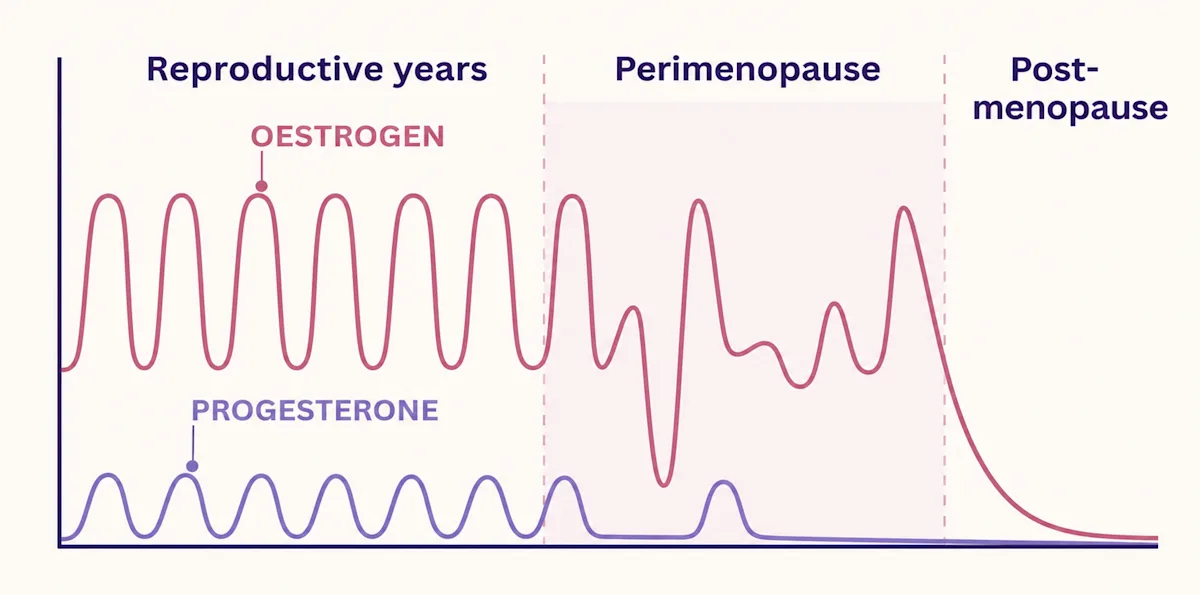
Source: Dr Paula Briggs, Fast Facts for Menopause
The decrease and variability of estrogen levels during perimenopause and menopause are the primary factors behind many physical, emotional, and long-term health changes linked to this transition. As ovarian function diminishes, the reduction of estrogen affects almost every major system within the body.
How menopause starts is almost always the same: with a change to your periods. The NHS notes that periods "may happen more often or less often, and bleeding may get heavier or lighter" before they stop altogether. Cycles that stretch to 40 or 50 days, then snap back to 24, are the signature pattern, and longer, heavier bleeding is part of it.
Beyond periods, the recognised list is longer than most women expect:
Category | Symptoms |
|---|---|
Periods | Cycles closer together or further apart; heavier or lighter bleeding; longer periods; periods eventually stopping |
Vasomotor | Hot flashes across the face, neck and chest; night sweats; palpitations |
Sleep and energy | Difficulty falling or staying asleep; fatigue |
Mood and cognition | Mood swings, low mood or depression; anxiety; problems with memory or concentration, often described as brain fog |
Genitourinary | Vaginal dryness, burning, irritation or itching; discomfort during sex; reduced libido; urinary incontinence; more frequent UTIs |
Body-wide | Weight gain around the stomach and upper body; muscle aches and joint pains; headaches and migraines; hair thinning or loss; dry, itchy skin; dental problems; weakening bones |
Symptoms shift across the transition rather than staying fixed, and the experiences can vary substantially from person to person. Furthermore, the psychological arrives alongside the physical: anxiety at 45 with no obvious trigger is as plausible a hormone symptom as a hot flash.
Unusual menopause symptoms nobody connects to hormones
Estrogen acts on tissue all over the body, not just the reproductive tract, which is why the less obvious symptoms get misattributed. Below are some of the recognised symptoms of perimenopause and menopause:
Joint and muscle aches, often mistaken for early arthritis or overtraining
Dental problems, including sore or receding gums
Dry, itchy skin and thinning hair
Headaches and migraines, or a change in a pattern you have had for years
Heart palpitations
Recurrent UTIs or UTI-like symptoms with no infection found
Which symptoms point to early menopause?
Early menopause symptoms are no different from the list above. What changes is the timing, and what it means for your bones, heart and fertility. Influencing factors include a family history of early menopause, smoking, chemotherapy or pelvic radiotherapy, surgery to remove the ovaries, and some autoimmune conditions.
Do you need a blood test?
An FSH test is recommended for women aged 40 to 45 with menopausal symptoms including a cycle change, and for women under 40 where premature ovarian insufficiency is suspected.
If you want a fuller picture, particularly if fertility decisions are still open, an at-home fertility and hormone test measuring FSH, LH, estradiol and AMH gives you something concrete to bring to the appointment. Our guide to when to get a hormone check covers the timing, which matters more than most people realise.
The Ovasave Take-Home
Menopause symptoms are common, expected and treatable. Watch for a cluster: cycle changes plus two or three other symptoms arriving together, including the ones that don't look hormonal at all. You do not need a blood test to be taken seriously after 45, and you do not need to wait until symptoms are unbearable to ask for treatment. If your periods stopped before 45, or these signs are showing up closer to 40, take it to a doctor sooner rather than later. To understand the hormone shifts underneath all of this, our explainer on perimenopause and the hormonal changes before menopause picks up where this leaves off.
Quick FAQs
Most women reach menopause between 45 and 55. Symptoms typically begin several years earlier and they can last 7 to 9 years.
Not fundamentally. Both ages usually fall inside perimenopause, and the NHS describes the same symptom set across the whole transition. What tends to change is the period pattern, which generally becomes more irregular the closer you get to your final period.
Yes. Bleeding may get heavier or lighter and periods may come more or less often, so longer periods are a recognised part of the transition.
Only in hindsight. Menopause is confirmed after 12 consecutive months with no bleeding at all, so your last period before menopause is identified retrospectively and any bleeding within those 12 months restarts the clock.
Yes. Fertility declines significantly but does not stop until menopause is complete, so contraception is still advised through perimenopause. If pregnancy is something you are still considering, you should not delay it any further and immediately consult with your doctor to understand next steps.
References
Ovasave’s articles are written after carefully evaluating evidence-backed sources and are reviewed by medical professionals to ensure the highest standards of accuracy.
World Health Organization. Menopause fact sheet. https://www.who.int/news-room/fact-sheets/detail/menopause
National Institute on Aging (NIH). What Is Menopause? https://www.nia.nih.gov/health/menopause/what-menopause
NHS. Menopause and perimenopause. Symptoms. https://www.nhs.uk/conditions/menopause/symptoms/
NHS. Menopause and perimenopause. Treatment. https://www.nhs.uk/conditions/menopause/treatment/
NHS. Early menopause. https://www.nhs.uk/conditions/early-menopause/
NHS. Postmenopausal bleeding.https://www.nhs.uk/conditions/post-menopausal-bleeding/
NICE. Menopause: identification and management (NG23). Recommendations. https://www.nice.org.uk/guidance/ng23/chapter/recommendations
Office on Women's Health, U.S. Department of Health and Human Services. Early or premature menopause. https://womenshealth.gov/menopause/early-or-premature-menopause
Mishra GD et al. Early menarche, nulliparity and the risk for premature and early natural menopause. Human Reproduction 2017;32(3):679–686.. https://academic.oup.com/humrep/article/32/3/679/2937790
Centers for Disease Control and Prevention. About Heavy Menstrual Bleeding. https://www.cdc.gov/female-blood-disorders/about/heavy-menstrual-bleeding.html
Health Service Executive (Ireland). Contraception and menopause. https://www2.hse.ie/conditions/contraception-and-menopause/